
How Much Does a Swim Spa Cost to Run in Michigan?
It is the question that comes up in every swim spa conversation after price, and the honest answer is that it depends on four things: how well the spa is insulated, what temperature you keep it at, how often you use the swim current, and what your utility charges per kilowatt-hour. Anyone who gives you a single flat number without asking about those is guessing.
What we can do is show you exactly which factors move the number, roughly how much each one matters, and how to estimate your own cost using your own electric bill. That is more useful than a number pulled from a different climate and a different rate structure.
Where the electricity actually goes
A swim spa draws power in three places, and they are not equal.
- Holding temperature. This is the bulk of it. The heater cycles on to replace heat lost to the air, and it runs whether or not anyone gets in. In a Michigan January it runs more than it does in July.
- The swim current. Propulsion draws real power, but only while you are using it. Thirty minutes of swimming a few times a week is a modest addition to the monthly total.
- Circulation and filtration. A low-draw circulation pump runs on a schedule to keep water moving through the filter. Small, steady, and easy to overlook.
Because heat retention dominates, the things that reduce heat loss are the things that reduce your bill. That is why insulation and cover quality matter more to operating cost than horsepower or jet count.
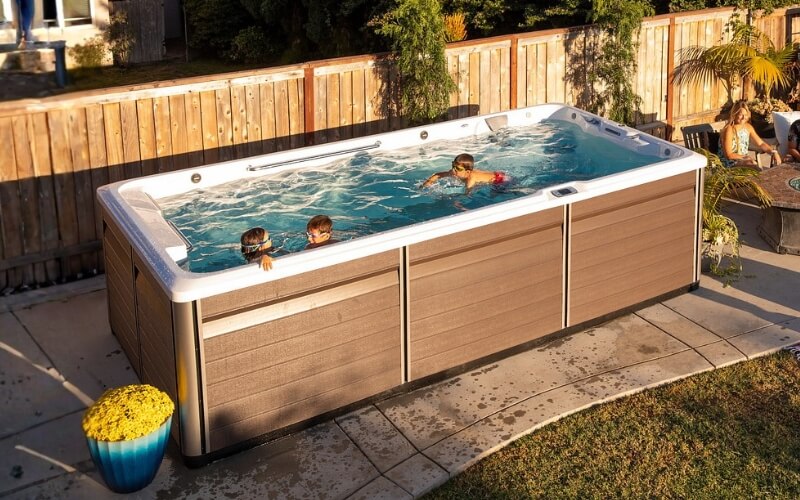
What drives the number up or down
Insulation and cabinet construction
A fully insulated shell and cabinet keeps heat in the water instead of releasing it into a cold back yard. This is the single biggest structural difference between an efficient swim spa and an expensive one to own, and it is also the hardest thing to change after purchase. It is worth asking about specifically when you compare models.
The cover
Heat escapes fastest from the water surface, so the cover is doing more work than anything else on the spa. A cover that has absorbed water has lost most of its insulating value even if it still looks fine. A rigid, powered cover like a Covana seals differently than a folding vinyl cover and is easier to use consistently, which matters, because the best cover is the one that actually gets closed every time.
Set temperature
Every degree you hold costs money all winter. Swim spas are often kept cooler than a hot tub, since a temperature that feels good for swimming laps is lower than one that feels good for soaking. Dual-zone models solve this by keeping a small hot section separate from the larger swim section, which is worth understanding if you want both experiences without heating the whole volume to soaking temperature.
Where you put it
An exposed spot on the windward side of the house loses more heat than a sheltered corner. A fence, a wall, or landscaping that blocks prevailing wind reduces convective heat loss for free.
Your electric rate
Two neighbors with identical spas can pay different amounts if they are on different rate plans. If your utility offers time-of-use pricing, running filtration and reheating during off-peak hours can shift a meaningful piece of the cost.
How to estimate your own monthly cost
You do not need a model-specific number to get a usable estimate. Do this instead:
- Find your rate per kilowatt-hour on your electric bill. It is usually printed as a per-kWh charge, and you want the all-in delivered rate, not just the supply portion.
- Ask us for the manufacturer’s estimated energy consumption for the specific model you are considering, at a stated set temperature and ambient condition.
- Multiply the estimated monthly kWh by your rate.
- Add a modest allowance for swim current use based on how often you plan to swim.
Manufacturer figures are measured under controlled conditions, so treat the result as a floor rather than a ceiling, and expect winter months to run above the annual average and summer months below it. When you visit a showroom, ask to see the published energy specifications for the E-Series, X-Series, and R-Series side by side. The differences between series are real and they show up on your bill every month for years.
Does running it through a Michigan winter cost a fortune?
It costs more in winter than in summer, which surprises nobody. What surprises people is how much less dramatic the difference is than they expect on a well-insulated, well-covered unit. Cold air increases the rate of heat loss, but a sealed cover and an insulated cabinet limit how much heat is available to lose in the first place.
The other thing worth saying plainly: shutting a swim spa down for the winter is usually the wrong move financially and practically. Draining and winterizing costs money and labor, reheating a full volume in spring costs a large slug of energy at once, and you lose the months when an indoor-quality warm swim is most appealing. Most owners run year round.
Snow on the cover is not a problem in itself, though you should clear heavy accumulation so the weight does not stress the cover, and keep the equipment bay accessible in case a technician needs to get to it in February.
Ways to lower the cost without giving anything up
- Replace a waterlogged cover. It usually pays for itself faster than owners expect.
- Keep the filter clean. A restricted filter makes the circulation pump work harder for less flow.
- Drop the set temperature a degree or two and see whether you notice. Most people do not.
- Block the wind on the most exposed side.
- Use the swim current in focused sessions rather than leaving it running while you rest between sets.
- Stay on top of water chemistry so the equipment is not fighting scale buildup. Our water care guides cover the basics.
Common questions about swim spa operating costs
Is a swim spa cheaper to run than a pool?
Generally yes, because a swim spa holds a fraction of the water volume of an inground pool and is insulated and covered, while a pool loses heat and water continuously from an open surface. A pool also carries seasonal opening and closing costs that a year-round swim spa does not.
Should I turn my swim spa off when I am not using it?
No. Letting the water cool and reheating it repeatedly generally uses more energy than holding a steady temperature, and it is harder on water chemistry. Leave it at temperature and use the cover.
Can I use a swim spa outdoors all winter in Michigan?
Yes. Swim spas are built to run year round in cold climates. The practical considerations are keeping the cover clear of heavy snow, maintaining a safe path to the spa, and keeping the equipment area accessible for service.
What uses more power, the heater or the swim current?
Over a month, the heater, by a wide margin. The swim current draws more power in the moment but runs only during your swim, while the heater cycles all day and all night to hold temperature.
See the numbers on a specific model
The most useful conversation is a specific one: your yard, your rate, and the model you are actually considering. Take a look at the Endless Pools swim spa lineup, use our find the perfect swim spa tool to narrow it down, or visit one of our seven Michigan showrooms in Ann Arbor, Fenton, DeWitt, Novi, Rochester Hills, and Saginaw to see them in person. You can also request pricing or call 810-629-6200 and we will walk through the operating cost math with you. Financing is available with approved credit.